
%20%E2%80%94%20How%20to%20Protect%20Your%20CICD%20Pipelines.png)
On April 20, 2026, the Cybersecurity and Infrastructure Security Agency (CISA) issued an alert on the compromise of the axios package in the npm ecosystem.
This incident is being tracked as MAL-2026-2307 and highlights a growing class of npm supply chain attacks that propagate through automated CI/CD systems. More importantly, it shows how quickly a trusted dependency can become a distribution vector.
If you’re dealing with npm security in distributed CI/CD environments, we’ve previously outlined how runtime enforcement works in practice (not just scanning after the fact).
This alert builds on the late-March incident, where attackers gained access to a maintainer account and published malicious versions of axios that delivered a remote access payload through a hidden dependency.
Axios is one of those packages that quietly sits everywhere, from frontend apps and backend services to internal tooling, pulling in over 100 million downloads per week.
That kind of footprint is what turns a short-lived compromise into something much more systemic.
What actually broke in the Axios Supply Chain Attack
This wasn’t a bug in axios itself. What failed was trust in how the package was distributed.
Malicious versions were published that looked legitimate and resolved like any other dependency. In this case, the affected versions were axios@1.4.1 and axios@0.30.4, both of which introduced a hidden dependency that executed a cross-platform remote access payload during installation.
This activity has been tracked as MAL-2026-2307 in OSV.dev, marking these versions as malicious and enabling downstream systems to automatically enforce policies against them.
From the outside, nothing looked unusual. But any CI system resolving dependencies during that window could have pulled and executed that code automatically. In practice, simply running a build was enough.
What changed in real time
One of the more interesting aspects of this incident is how quickly it was contained once identified.
OSV.dev aggregated the malicious package intelligence, and Artifact Firewall began enforcing it almost immediately—without requiring users to manually create or maintain rules. In practice, this means teams didn’t need to discover the issue, write rules, or deploy changes–enforcement simply followed the upstream intelligence.
You can see that moment publicly here:
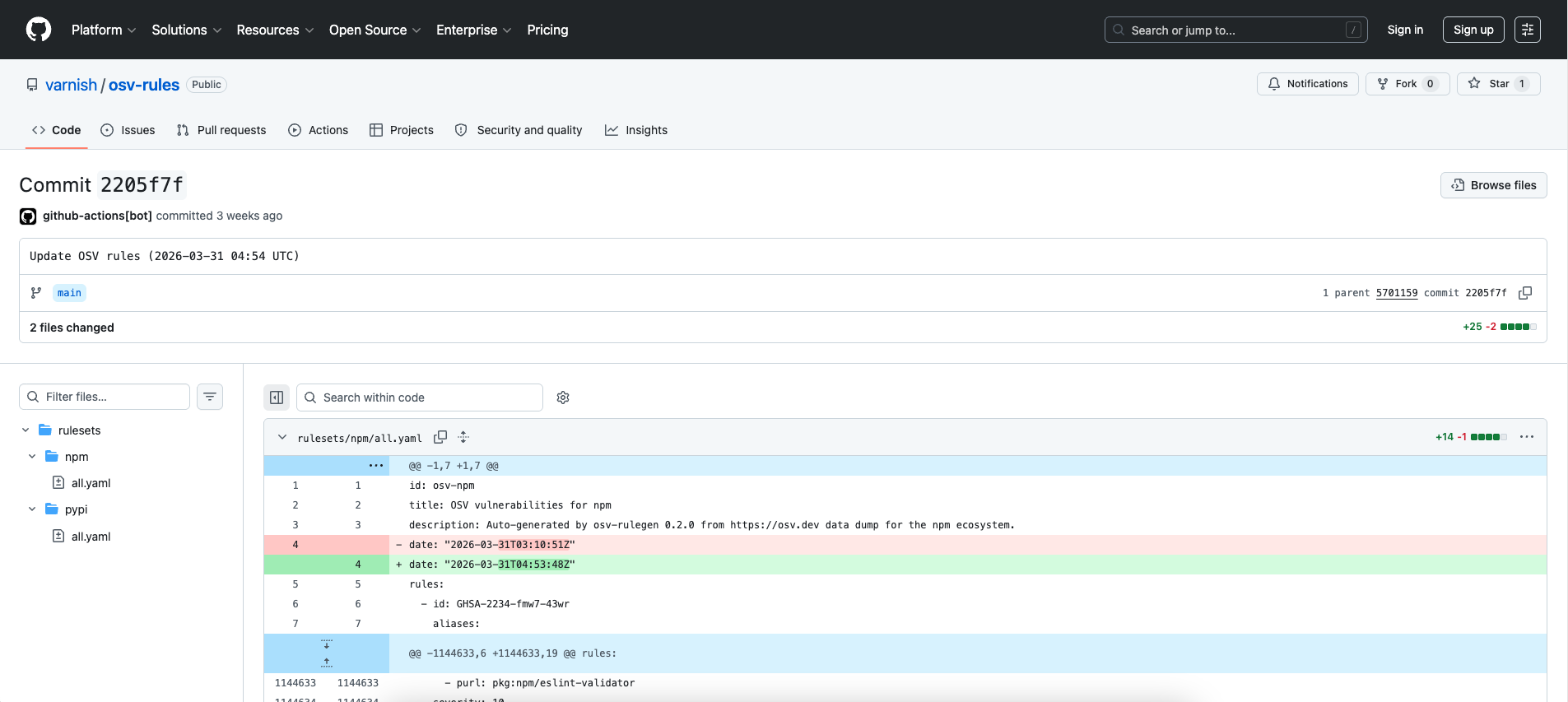
That commit marks the point in time where the affected axios versions were turned into enforceable policy. From there, any request for those versions could be blocked at the moment of access.
The important detail is that this wasn’t a manual response. The vulnerability data was aggregated externally, and Artifact Firewall enforced it directly.
Why this matters more than previous incidents
A lot of supply chain security still revolves around detection: scan dependencies, identify issues, and then fix them.
That approach assumes you have time.
In this case, the malicious versions were only available for a few hours. In a modern CI/CD environment, especially one with automated or machine-driven workflows, that’s more than enough time for those versions to propagate across builds, regions, and teams.
So the issue isn’t just visibility. It’s the gap between publication and enforcement, and how much can happen inside that window.
Where existing controls fall short
Most organizations already have some combination of repository controls, scanners, and policy lists in place. Those are important, but they tend to operate either before ingestion or after the fact.
What they don’t control is the moment a dependency is actually requested.
Once a compromised version is upstream and available, most systems will accept and execute it before any downstream control has a chance to intervene. That’s exactly what the axios incident exposed.
What changes when you enforce at request time
To really contain something like this, control needs to sit closer to where dependencies are resolved.
This is exactly where Artifact Firewall operates as a control point between your registries and your CI/CD systems, evaluating every dependency request before it’s fulfilled. Instead of relying on what was scanned or stored earlier, it makes a decision in real time before a package is delivered to a build or runtime environment.
In the context of the axios compromise, that means you’re not waiting for downstream tools to catch an issue. You’re deciding, at the moment of access, whether a dependency should be allowed through at all.
Practically, that gives you a few immediate levers:
-
Block known bad versions like
1.4.1and0.30.4so they are never resolved -
Delay newly published versions before making them available internally
-
Enforce policies on package identity and source before anything is delivered
Just as importantly, those decisions don’t rely on manual rule creation. External sources like OSV.dev provide the signal, and Artifact Firewall applies it automatically.
Why a quarantine would have changed the outcome
There’s another angle here that’s easy to miss, but it’s critical.
Artifact Firewall already includes a built-in capability for this: package quarantine (referred to as time-gated release protection), which delays the availability of newly published packages for a defined period.
In the case of the axios compromise, the malicious versions (1.4.1, 0.30.4) were only available upstream for a short window before being identified and removed.
With a quarantine policy in place, those versions would not have been immediately available to CI/CD pipelines. Instead, they would have been held back long enough for the issue to be discovered and for enforcement rules (like the OSV-based block) to be applied.
In practical terms, that means most environments would never have consumed the compromised versions at all. In other words, this attack would have expired before it ever reached your pipelines. That’s the difference between reacting to a supply chain attack and never seeing it at all.
This is an important shift. It’s not just about identifying bad packages after they appear. It’s about controlling when new packages are allowed into your environment so that short-lived compromises don’t turn into widespread incidents.
A practical takeaway
The axios incident highlights two things clearly:
- First: detection alone is not enough in highly automated environments.
- Second: the most effective control point is the moment a dependency is requested.
The question is no longer just “is this package vulnerable?” but “should this request be allowed right now?”
Learn more
For a deeper look at how runtime enforcement can be applied to npm in distributed CI/CD environments, check out our blog: Artifact Firewall: Enforcing npm Security Across Distributed CI/CD Pipelines
If you’re running distributed CI/CD and want to see how this works in practice, you can try Artifact Firewall with OSV-backed policies enforced out of the box.